How to Build a Wedding Day Timeline That Doesn't Make You Hate Your Wedding
A good wedding timeline isn't about scheduling every minute of your existence from the moment you wake up until somebody drunkenly loses a shoe on the dance floor.
It's about giving your day enough structure that you don't have to manage it while you're trying to get married.
Your vendors know where they're supposed to be.
The important shit has enough time.
Nobody realizes thirty minutes before the ceremony that getting from the hotel to the venue actually takes twenty-five.
And you aren't spending your wedding constantly checking the time and asking:
“Wait. What are we supposed to be doing right now?”
I've photographed more than 150 weddings, and I've helped build, adjust, troubleshoot, and occasionally rescue a whole fucking lot of wedding timelines along the way.
So this guide isn't here to give you one magical schedule that every wedding should follow.
It's here to help you understand how the pieces actually fit together, how much time things realistically take, where people tend to underestimate the logistics, and how your photography coverage fits into all of it.
We'll talk first looks, family photos, getting ready, travel, sunset, receptions, buffer time, and I'll show you sample wedding timelines for different amounts of photography coverage.
Take what works for your wedding.
Ignore what doesn't.
The timeline works for you. Not the other way around.

FIRST THINGS FIRST
There Is No Perfect Wedding Timeline.
I know.
Deeply inconvenient considering you probably Googled something like “perfect wedding day timeline” to get here. 😂
But there isn't one.
A 150-person wedding with a Catholic Mass, three getting-ready locations, and a fourteen-person wedding party does not need the same timeline as forty people getting married at a cabin in the mountains.
A couple doing a first look has different logistics than a couple who doesn't want to see each other until the aisle.
A wedding where the ceremony and reception are forty minutes apart needs more breathing room than one where everything happens on the same property.
And if your reception priorities are dinner, cake, and hanging out with your family, you don't need me building your photography coverage around three hours of dance-floor photographs you couldn't give less of a shit about.
Your priorities determine the timeline.
Not Pinterest.
Not some template you downloaded.
Not what your cousin did at her wedding.
And not me.
My job is to help you understand the logistical consequences of the choices you're making so we can build a day that actually works.
Because the goal isn't to create the most photographically efficient wedding imaginable.
The goal is for you to actually enjoy your fucking wedding.
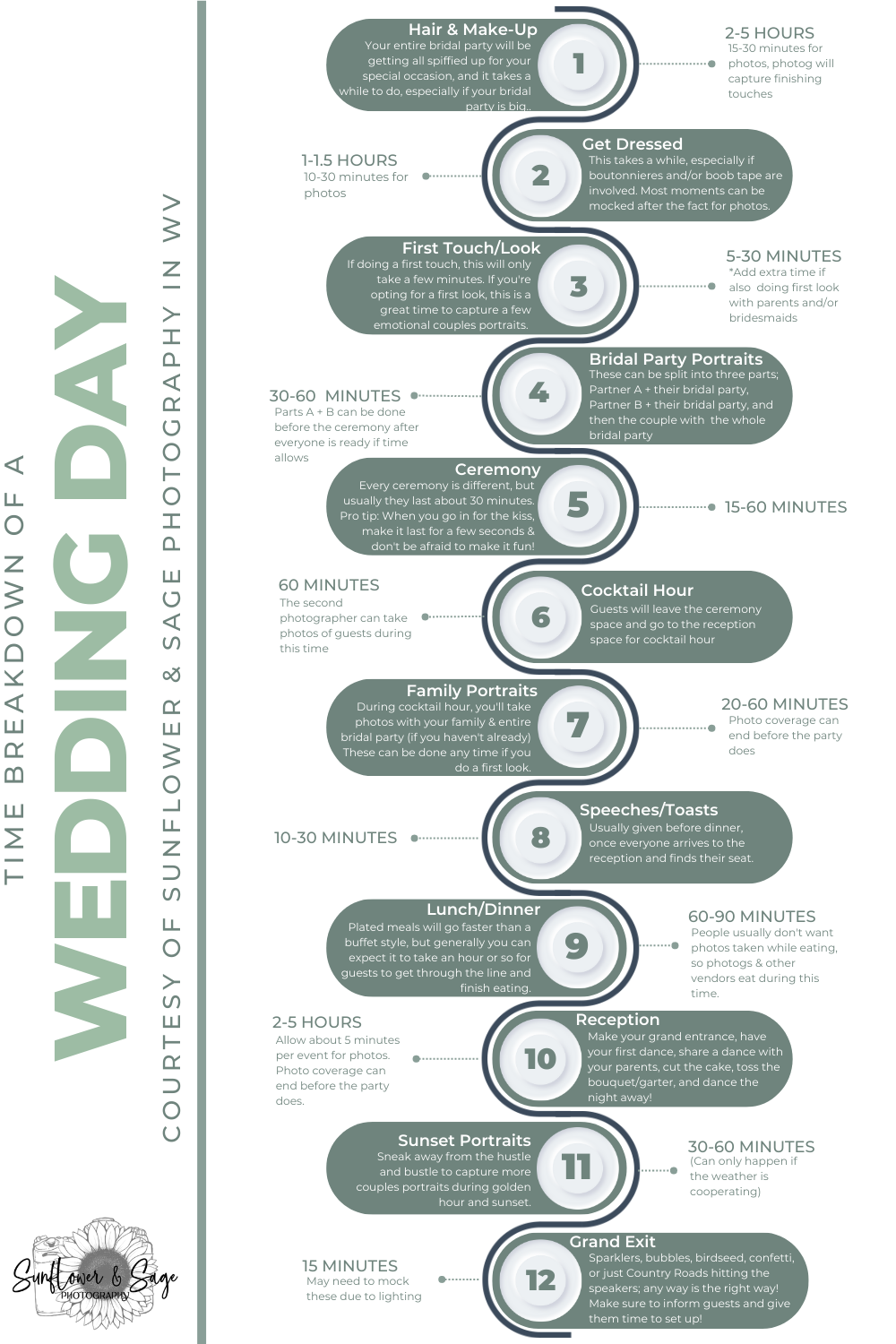

SO WHERE THE HELL DO WE START?
Start With the Things That Can't Move.
One of the easiest ways to make wedding timeline planning unnecessarily difficult is to start at:
8:00 AM — Wake Up
and then try to schedule your way forward through the entire day.
Don't.
Start with the anchors.
These are the things that either can't move at all or have a significant effect on everything around them:
Your ceremony time.
Especially if you're getting married at a church or venue with a fixed start time.
When you can access the venue.
You can't schedule getting-ready photographs somewhere you aren't allowed into yet.
Dinner.
Your caterer cares very much about when the food is supposed to be served, and cold chicken isn't worth better photographs.
Your venue's end time.
If everybody has to be out by 10:00 PM, that's a real deadline.
Travel.
Hotel to church. Church to reception. Getting-ready location to venue. Wherever the hell we're going, getting there takes time.
Anything with a fixed vendor schedule.
Transportation, hair and makeup, catering, entertainment, venue restrictions, or anything else that can't simply be shifted fifteen minutes because we're running behind.
Put those pieces on the timeline first.
Then we build everything else around them.
AND YES, SUNSET IS ONE OF THOSE THINGS.
The Sun Is an Inconsiderate Bitch.
It refuses to wait for dinner. It does not give a shit what your coordinator's spreadsheet says.
The sun is very unprofessional.
But knowing sunset time early in the planning process can save us from discovering later that the prettiest light of the entire day happens at the exact same time you've scheduled speeches, parent dances, cake cutting, and the ceremonial summoning of Great Aunt Linda.
That does not mean you need to disappear from your reception for forty-five minutes so I can frolic through a field with you.
Remember my philosophy:
Your wedding isn't a photoshoot with a ceremony inconveniently scheduled in the middle.
Sometimes all I want is five or ten minutes.
If the sky is doing something ridiculous, I might come find you and say:
“Hey. Outside. Now.”
We'll make something beautiful, give you a second alone together, and send you right back to your people.
When I'm helping one of my couples build their timeline, I check historic sunset times and look for places where we can create those little pockets without making the entire wedding revolve around photographs.
That's what a good timeline does.
It creates opportunities.
It doesn't create obligations.

OKAY, BUT HOW LONG DOES ALL THIS SHIT ACTUALLY TAKE?
Let's Talk Realistic Wedding Day Timing.
Here's the annoying photographer answer:
It depends.
Here's the considerably more useful answer:
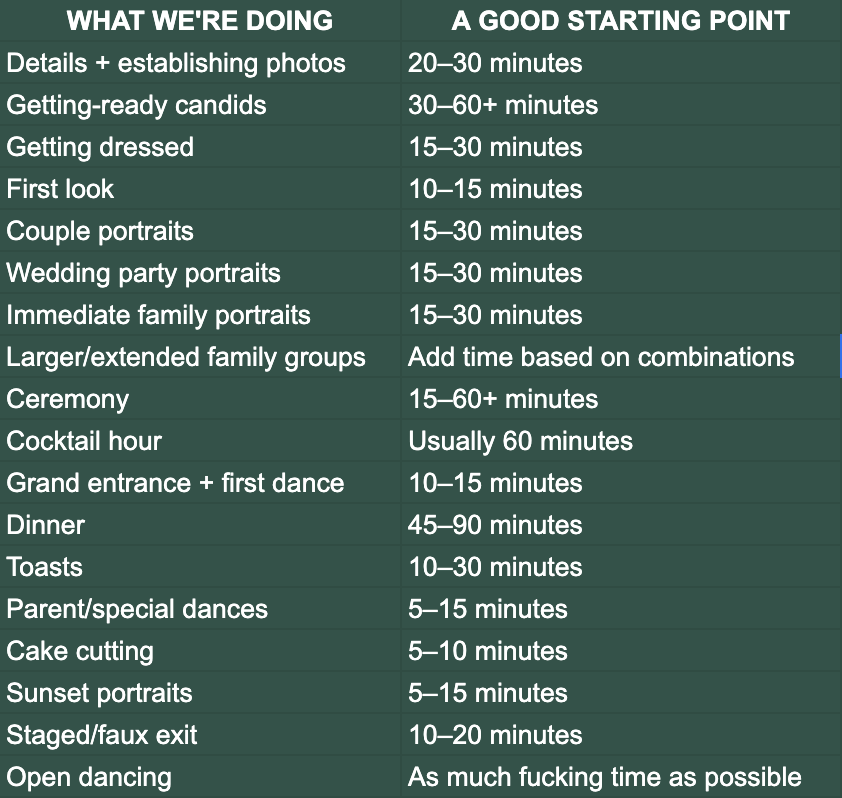
There are some pretty reliable starting points.
The size of your wedding party, number of family combinations, travel between locations, ceremony type, whether you're doing a first look, how many people are getting ready together, and approximately six billion other tiny decisions can change these numbers.
So please don't treat this table like commandments handed down from the Wedding Gods.
These are planning estimates.

DETAILS + GETTING READY
You Probably Don't Need Three Hours of Me Photographing Your Shoes.
Listen, I love a good flat lay.
Your invitations, rings, jewelry, flowers, heirlooms, perfume, cufflinks, vow books, and whatever weird sentimental thing you've decided belongs in the story absolutely deserve photographs.
But I don't need an hour and a half to arrange them like I'm preparing an offering to the Pinterest gods.
About 20–30 minutes is usually plenty for details and establishing photographs.
What I care about considerably more is what's happening around them.
People getting ready.
Music playing.
Coffee being consumed.
Someone doing makeup on the floor.
Your parent walking in and seeing you.
Your friends being idiots.
The nervous energy starting to build when everybody realizes:
Oh shit. We're actually doing this.
For getting-ready coverage itself, 30–60+ minutes per side is a useful starting point, depending on how much of that part of the story matters to you.
And here's an important distinction:
“Getting ready” and “getting dressed” are not the same thing.
If you want photographs of someone helping you into a dress, fastening jewelry, buttoning a jacket, tying a tie, putting on shoes, or whatever getting dressed looks like for you, give that part 15–30 minutes.
Not because putting on pants takes half an hour.
Because wedding clothes are weird.
Buttons fight back.
Tying a tie is hard.
People get emotional.
Someone can't find the earrings.
A parent needs to be located.
The photographer needs enough physical space to actually photograph what's happening.
And rushing this part tends to create exactly the frantic energy we're trying to avoid.

FIRST LOOKS
Ten Minutes Can Change the Entire Timeline.
A first look itself usually doesn't need much time.
About 10–15 minutes gives you enough time to actually see each other, react, hug, talk, cry, laugh, or stare at each other awkwardly while I wait for somebody to say something. 😂
But the reason first looks matter so much to the timeline isn't because the first look takes a long time.
It's because of what we can do afterward.
Once you've seen each other, we can potentially photograph:
- couple portraits
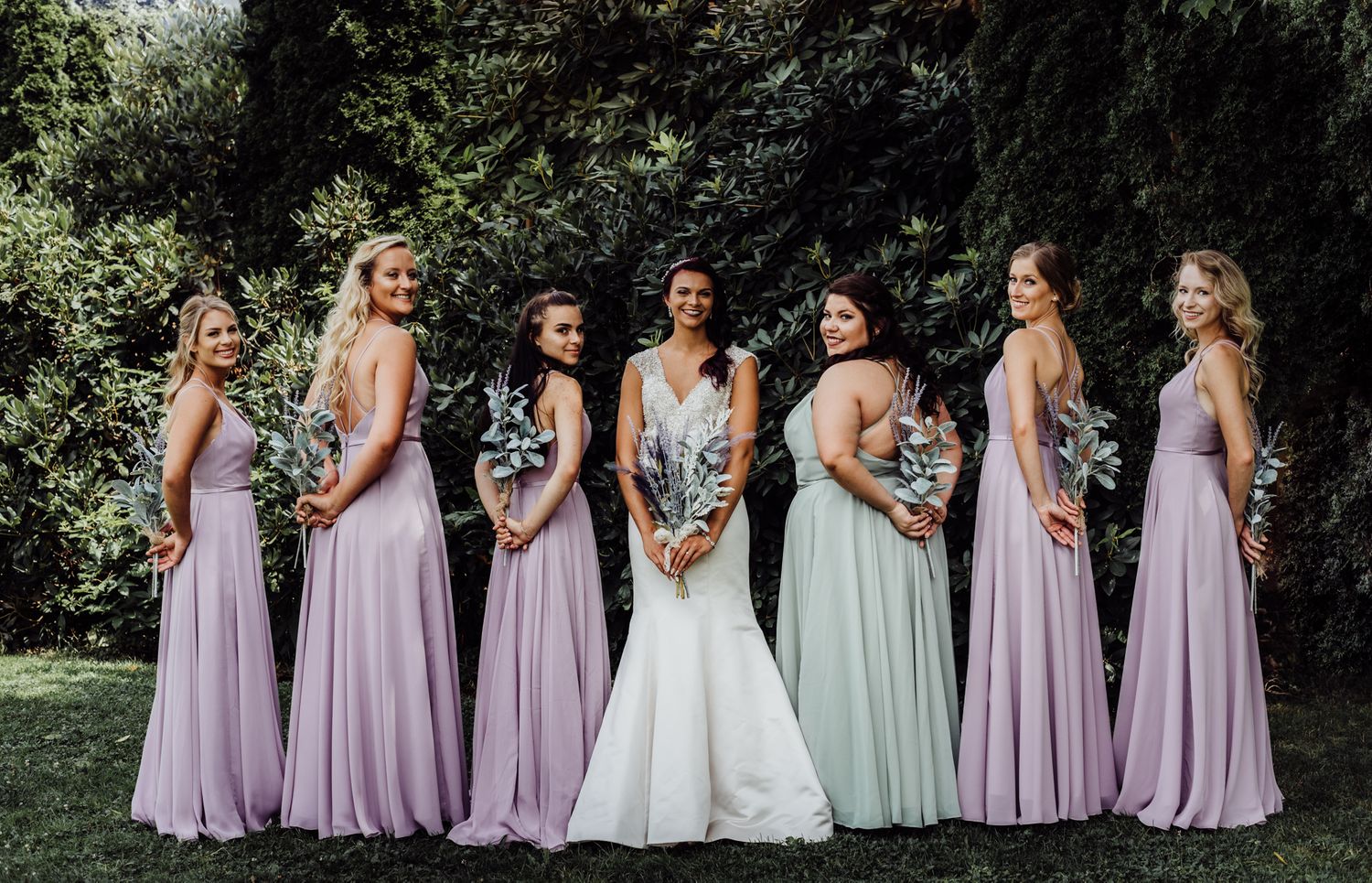
- the full wedding party
- immediate family
- sometimes extended family
before the ceremony.
That can completely change what your cocktail hour looks like.
Instead of spending most of it doing photographs, you might actually get to eat the appetizers you paid for.
Revolutionary concept, I know.
We'll get deeper into whether a first look makes sense for you in the next section, but for timing purposes:
Budget 10–15 minutes for the moment itself, then additional time for whatever portraits we're intentionally moving before the ceremony.

WEDDING PARTY PHOTOS
The Number of Humans Matters.
A four-person wedding party and a twenty-person wedding party are not the same logistical situation.
Shocking.
For most weddings, 15–30 minutes is a good starting point.
That gives us time for:
- the whole group
- each side/group separately
- you with your people
- your partner with theirs
- a few useful combinations
- some actual personality
If you've got a giant wedding party, lots of specific combinations you want, small children involved, or a group that has already begun enthusiastically visiting the bar...
give me more time. 😂
I don't need fifty different wedding-party poses.
I'd rather get the important photographs, let everybody fuck around for a minute, capture some personality, and then release them.
Your friends did not put on uncomfortable shoes to spend forty-five minutes standing in increasingly obscure geometric formations.

FAMILY PHOTOS
This Is Where “30 Minutes” Can Become 75 Real Fucking Fast.
Family photographs are one of the biggest timeline variables.
15–30 minutes works beautifully for a reasonable list of immediate-family combinations.
But every combination takes time.
You + parents.
You + siblings.
You + parents + siblings.
Both of you + one family.
Both of you + the other family.
Grandparents.
Stepparents.
Separate photographs with divorced parents.
Chosen family.
Extended family.
The entire side of the family who apparently hasn't been photographed together since 1997.
None of those requests are unreasonable.
But they add up.
My couples give me their family-photo combinations before the wedding so I can organize them into an order that makes sense instead of standing there asking:
“Okay... anybody else?”
If you have a particularly large list, we'll build more time into the timeline.
If you have complicated family dynamics, tell me beforehand.
I don't need the entire family history. (Although I do like tea... 😏)
I just need enough information to avoid cheerfully yelling:
“Okay! Mom and Dad, squeeze in like you like each other!”
when Mom and Dad would rather be launched directly into the sun than stand beside each other.
Planning saves everybody.

COUPLE PORTRAITS
You Do Not Need a Two-Hour Wedding Photoshoot.
For most weddings, 15–30 minutes of dedicated couple portraits is enough to create a hell of a lot of photographs.
Especially because I don't necessarily photograph all of them at once.
We might do:
10–15 minutes after a first look.
10 minutes after the ceremony.
5–10 minutes around sunset.
Those little pockets give us different light, different environments, and different energy without making you disappear from your own wedding for half the day.
If portraits are one of your absolute highest priorities?
Cool. We'll give them more room.
If you mostly want documentary coverage and approximately three photographs where Grandma can clearly see both of your faces?
Also cool.
The amount of portrait time should reflect how much you actually care about portraits.
Not how long somebody on Pinterest said wedding pictures are supposed to take.

CEREMONIES
Fifteen Minutes? Ninety Minutes? Who Knows.
Ceremonies are one place where I am absolutely not going to give you a magical universal number.
I've photographed ceremonies that were over before everybody's ass had fully settled into the chair.
I've photographed religious ceremonies that lasted well over an hour.
A short civil ceremony might be 10–20 minutes.
A typical nonreligious ceremony often lands somewhere around 20–30 minutes.
Religious ceremonies may be 45–90+ minutes, depending on the tradition and service.
The important thing is that we know what your ceremony is expected to look like.
Ask your officiant.
If you're getting married in a church, ask about photography restrictions while you're at it.
Some churches are wonderfully relaxed.
Others have Rules™.
I'd rather know about those before your wedding than discover five minutes before the processional that I'm apparently forbidden from existing anywhere except one specific square foot in the back corner. (Which, yes, IS a real thing.)

RECEPTION EVENTS
This Is Where Tiny Things Somehow Eat Forty Minutes.
Most individual reception traditions don't take very long.
A cake cutting might take five minutes.
Parent dances might take five to fifteen.
Toasts might take ten to thirty.
Your entrance and first dance might take ten-ish minutes.
But here's where people get fooled:
Transitions take time.
The DJ has to get everyone's attention.
People need to find their seats.
Someone giving a toast is in the bathroom.
Your dad disappeared.
The cake knife is apparently in another dimension.
Your coordinator is trying to get twelve people into the correct place.
So don't build a reception timeline that assumes:
7:00 First Dance
7:05 Parent Dance
7:10 Toasts
7:20 Dinner
because theoretically the math works.
Humans do not operate like calendar notifications.
Give reception events some breathing room.
And whenever possible, group the formal shit together so your guests aren't repeatedly interrupted all night.
Then open the dance floor and let everyone make questionable decisions in peace.
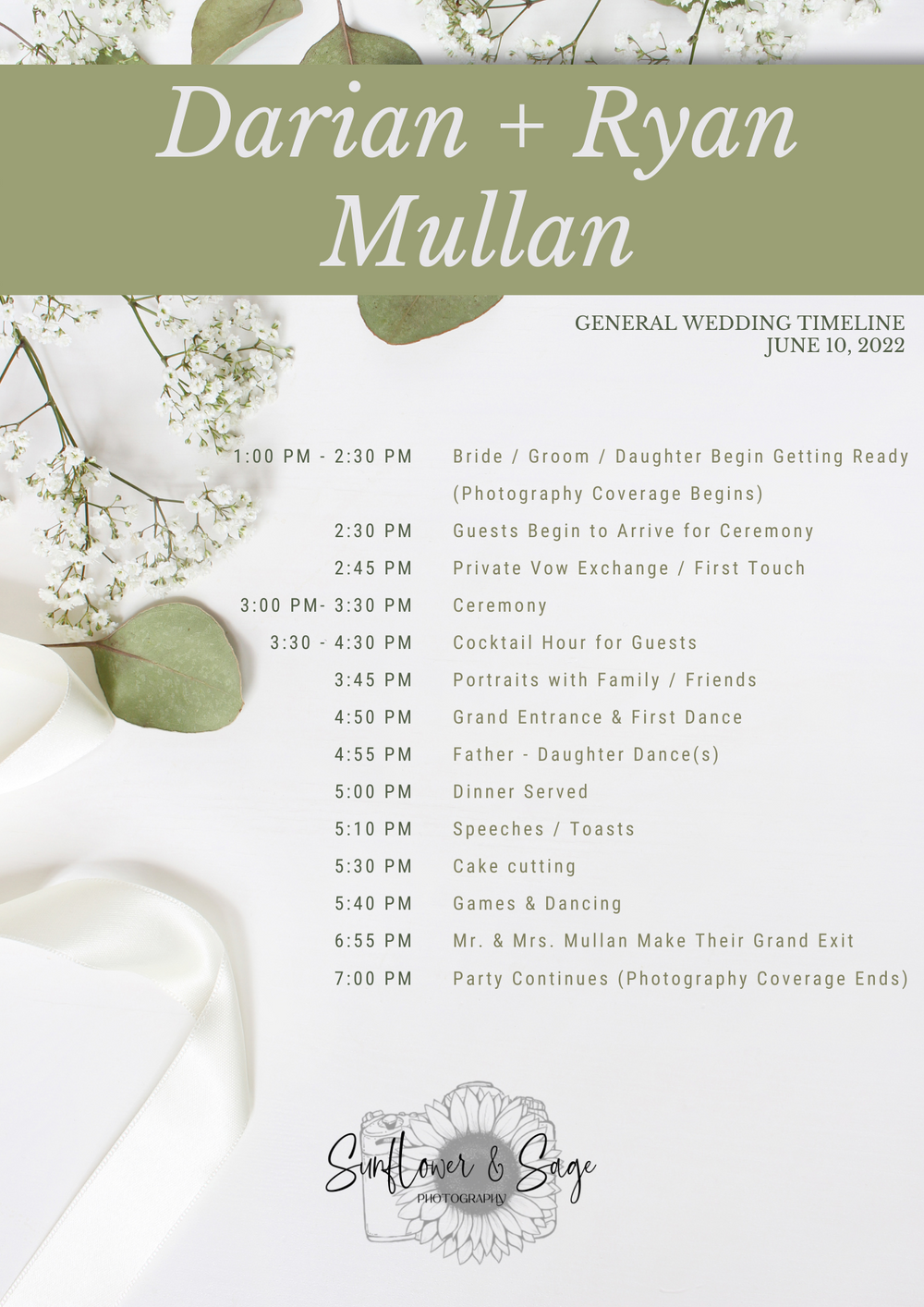
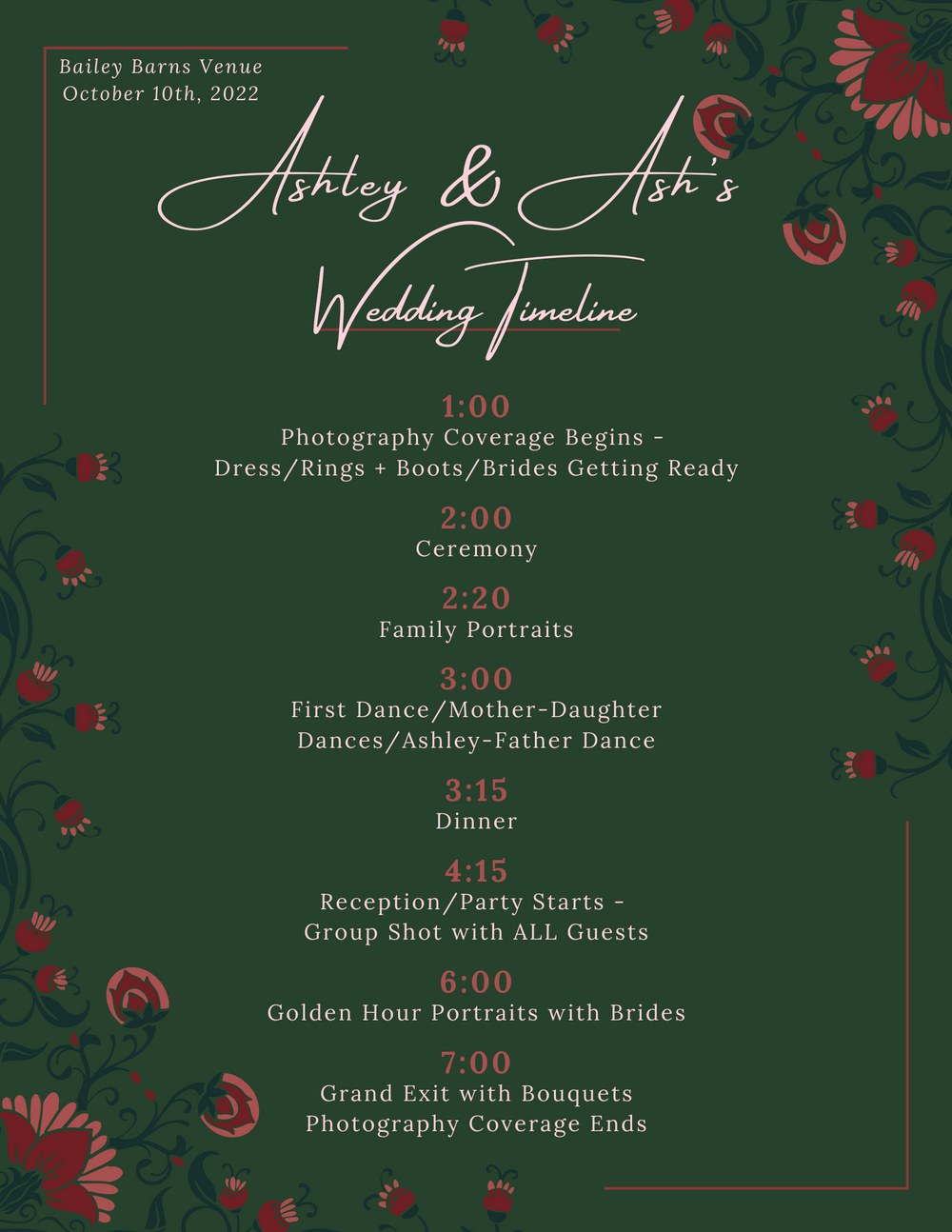
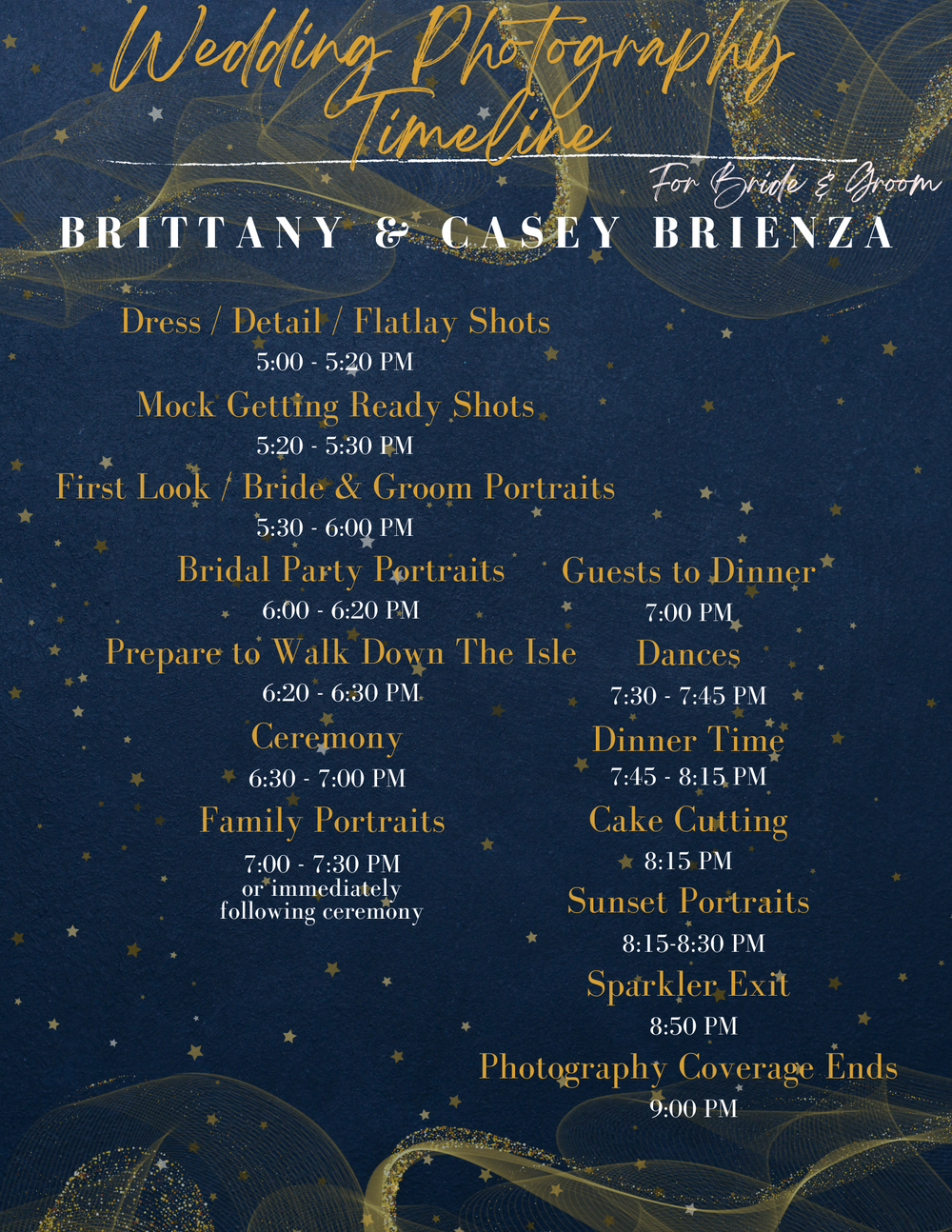
Examples of timelines I've created for couples:


SHOULD WE DO A FIRST LOOK?
Do You Fucking Want One?
That's the first question.
Not:
“Will my photographer be mad if we don't?”
Not:
“Pinterest says we should.”
Not:
“My cousin did one and said it saved her entire marriage.”
Do you want to see each other before the ceremony?
Because there are absolutely logistical benefits to a first look.
But there are also people who have spent years imagining the first time they see their partner being at the end of the aisle.
Neither choice is better.
They just create different wedding timelines.
IF YOU DO A FIRST LOOK...
We can potentially photograph a lot more before the ceremony.
Depending on your wedding, that might include:
- couple portraits
- wedding party portraits
- immediate family portraits
- sometimes extended family
That means after the ceremony, you may only need a few remaining family combinations and another quick round of couple portraits before heading to cocktail hour.
You might actually get to drink the signature cocktail you spent three months naming.
Beautiful.
A first look can also give the two of you a few relatively private minutes together before the wedding really takes off.
For some people, that calms the nerves considerably.
For others?
They'd rather wait.
IF YOU DON'T DO A FIRST LOOK...
Also completely fucking fine.
We'll simply build the timeline differently.
Most or all photographs involving both of you together will need to happen after the ceremony.
That usually means cocktail hour has more work to do.
We'll want family members to know where they're supposed to be immediately afterward.
We'll keep the family-photo list organized.
Wedding-party portraits need to move efficiently.
And depending on your priorities, you may spend more of cocktail hour taking photographs rather than attending it.
That's not a problem.
It's just a trade-off you should know about before the wedding day.
THERE'S ALSO A MIDDLE GROUND.
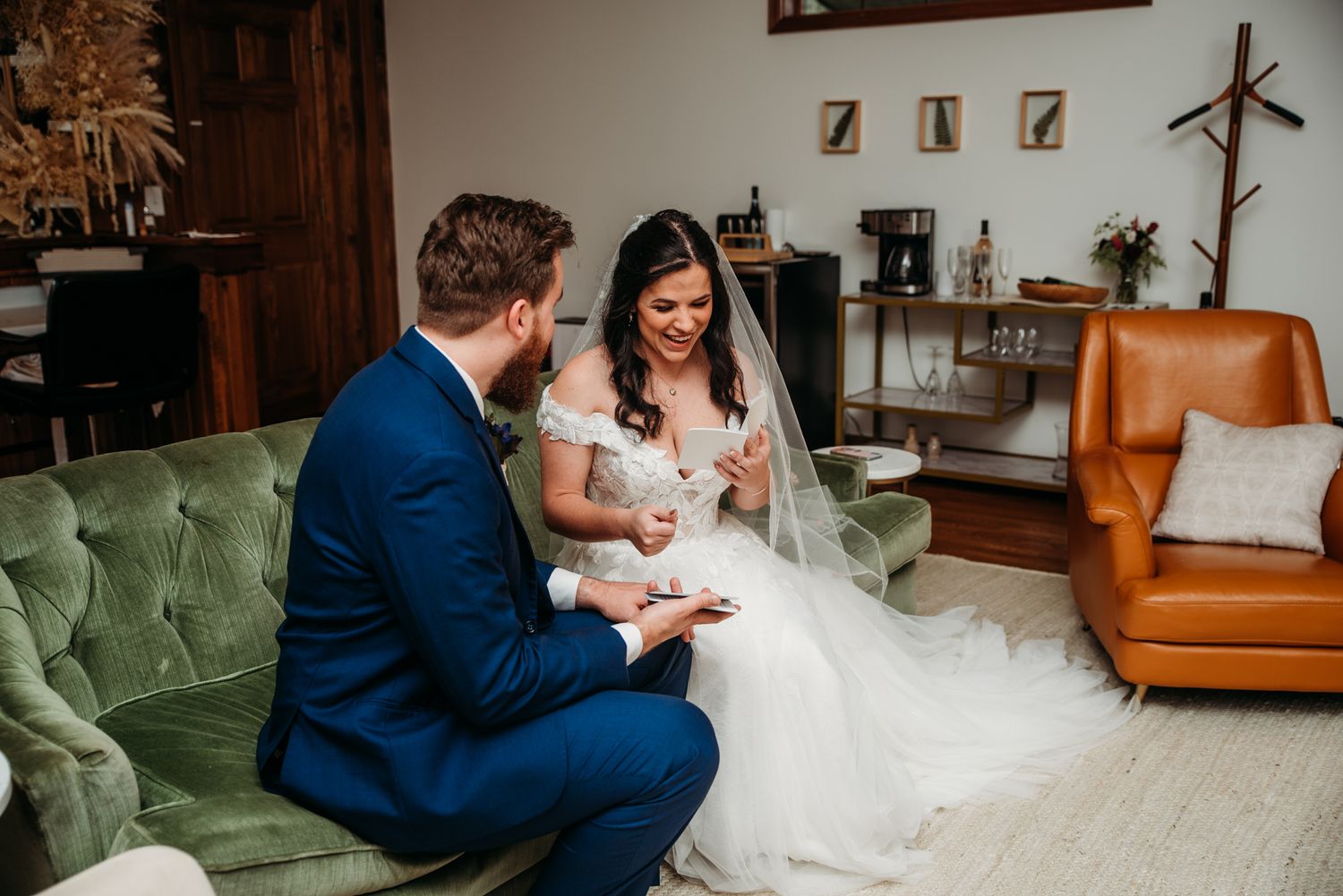
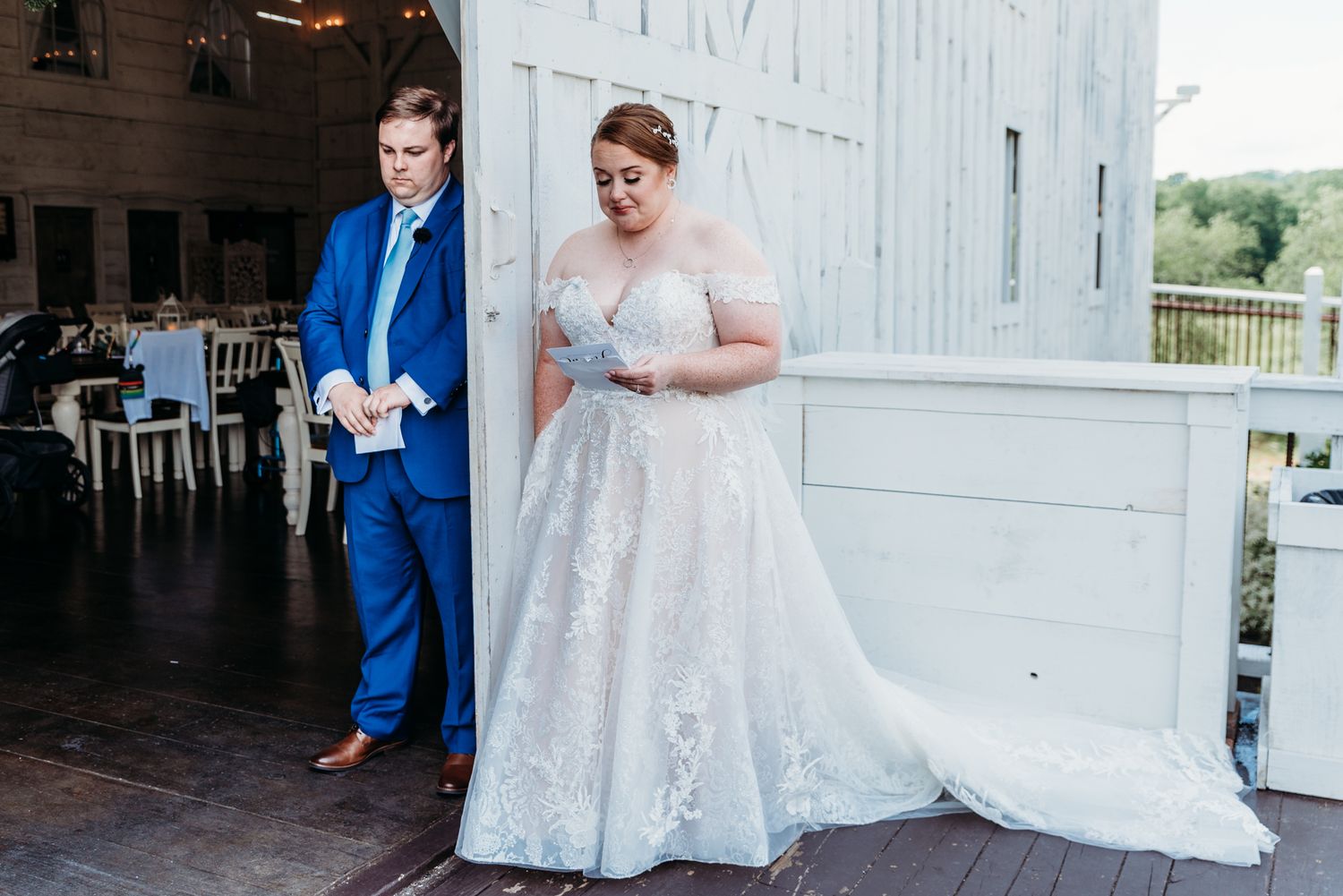
You don't have to see each other to spend a moment together.
I've photographed couples holding hands around corners, standing back-to-back, exchanging letters, praying together, sharing private vows, or just taking five minutes to talk without actually looking at each other.
People sometimes call this a first touch.
I call it:
Do whatever the hell means something to you.
If you want the aisle reveal and you want a quiet moment together beforehand, we can absolutely build both into the timeline.
The important thing isn't choosing the option that makes photography easiest.
It's knowing what you want and building the photography around it.

BUILD BUFFER TIME OR SUFFER.
Something Is Going to Take Longer Than You Think.
Maybe everything runs perfectly.
Hair and makeup finishes exactly on time.
Everyone gets dressed without incident.
Nobody forgets anything.
Transportation arrives precisely when scheduled.
Every family member materializes exactly where they're supposed to be.
And Grandma does not announce that she needs to pee thirty seconds before family photographs.
In that case?
Congratulations.
You've apparently angered absolutely none of the wedding gods. 😂
But I wouldn't build your timeline assuming that's going to happen.
Wedding delays usually aren't dramatic.
They're tiny.
Hair and makeup takes ten minutes longer.
Someone can't find their shoes.
The dress has forty-seven buttons apparently designed by Satan himself.
The shuttle hits traffic.
A groomsman wandered off.
The bustle is confusing.
Someone important is having a moment.
Guests take longer than expected to leave the ceremony space.
One tiny delay isn't a big deal.
The problem is when every event on the timeline is scheduled directly against the next one.
Ten minutes becomes twenty.
Twenty becomes thirty.
And suddenly we're deciding whether to shorten portraits, delay dinner, or perform a small miracle.
SO WHERE SHOULD THE BUFFER GO?
I generally like 10–15 minutes of breathing room around the parts of the day most vulnerable to delays.
Especially:
- the end of hair and makeup
- getting dressed
- leaving for another location
- before the ceremony
- immediately after family portraits
- before major reception events
That doesn't mean your timeline needs random blocks labeled:
3:15–3:30 PM — STAND AROUND AND DO FUCK ALL.
Although honestly, I'm not opposed.
It just means we don't schedule everything so tightly that one missing earring destroys Western civilization.
And if we're ahead of schedule?
Fantastic.
Sit down.
Eat something.
Drink water.
Talk to your people.
Take ten minutes where nobody is asking anything from you.
Unused buffer time isn't wasted time.
It's breathing room.

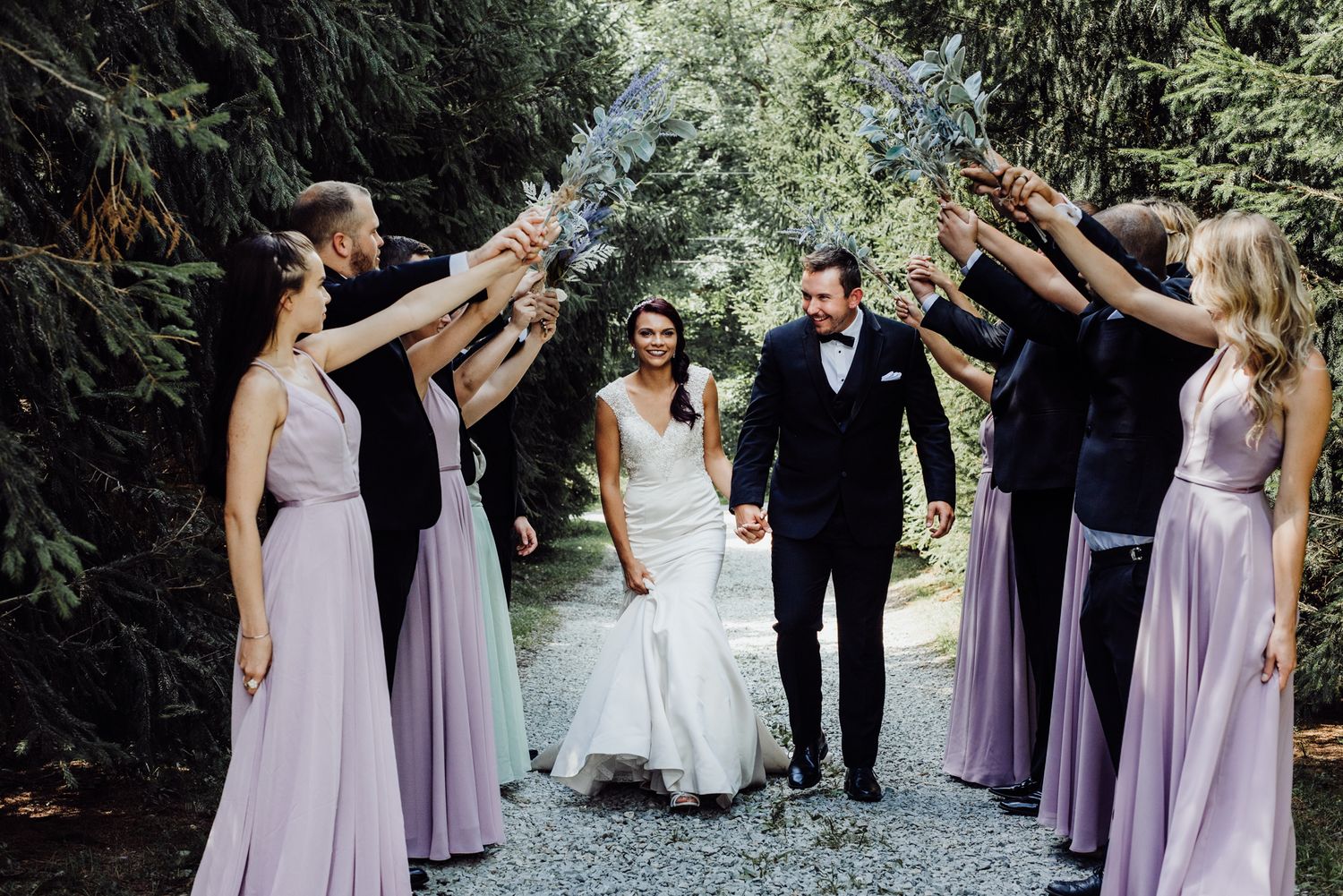
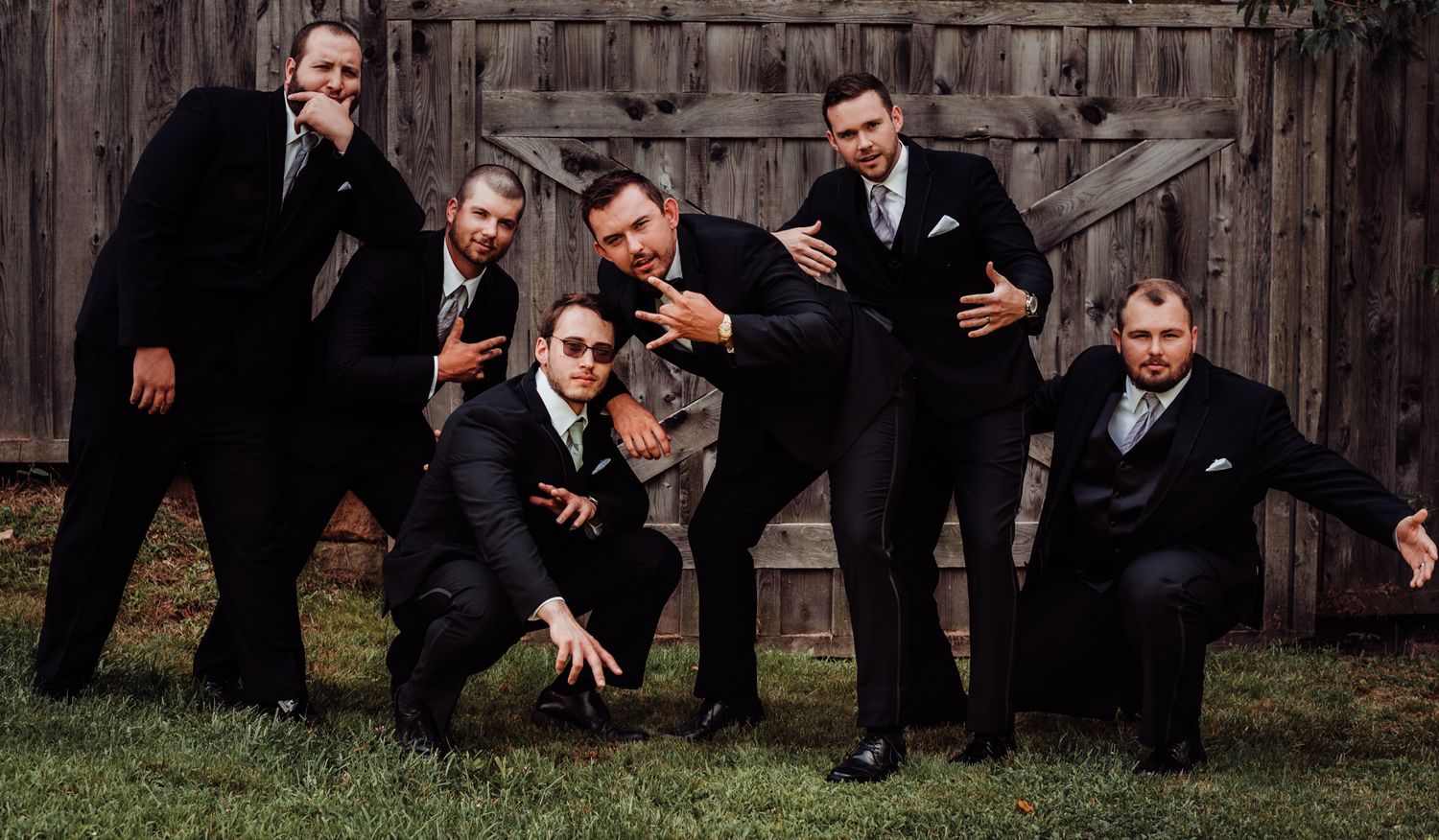
SPEAKING OF DOING ABSOLUTELY NOTHING...
Put Absolutely Nothing on the Timeline.
Yes.
I'm serious.
At some point during your wedding day, I want there to be a small block of time where you are not:
taking photographs,
greeting guests,
signing something,
cutting something,
dancing with somebody,
listening to a speech,
being introduced,
or standing somewhere because a vendor told you to.
Nothing.
Fifteen or twenty minutes is beautiful.
Go somewhere private.
Close the door.
Eat the food you paid for.
Drink some fucking water.
Take your shoes off.
Look at your new spouse.
Say:
“Holy shit. We're married.”
And maybe even squeeze in a quickie. 🤷🏼♀️
Because wedding days are weird.
You can spend a year or two planning one, and then when it actually arrives, you're surrounded by people who love you, vendors are moving around you, music is playing, everybody wants your attention, and the entire day somehow happens at approximately seventeen times normal speed.
It's very easy to experience your own wedding almost entirely through what comes next.
What's next?
Where do we go?
Who needs us?
What are we doing?
When's dinner?
When are speeches?
When do we cut the cake?
Stop.
For fifteen minutes, there is no next thing.
And unless you specifically want me there?
I'm not coming with you.
There does not need to be photographic evidence of every second of your wedding for that second to matter.
Actually, some of the most important parts might be the ones nobody photographs at all.
Build the break into the timeline.
Protect it.
Your wedding will still be there when you come back.

SO... HOW MANY HOURS OF WEDDING PHOTOGRAPHY DO YOU ACTUALLY NEED?
Let's Look at What Different Amounts of Coverage Actually Feel Like.
This is where “six hours” and “eight hours” stop being abstract numbers on a pricing page.
Because honestly?
If you've never planned a wedding before, how the fuck are you supposed to know what two additional hours actually changes?
So let's use the same imaginary wedding with a 4:00 PM ceremony and look at what different amounts of photography coverage could realistically include.
These aren't templates you need to copy exactly.
Your ceremony time, locations, first-look decision, family size, reception plans, sunset, travel, and priorities will change things.
But they'll give you a pretty damn good idea of what you're choosing.
4 HOURS
The Intimate Wedding Timeline
2:30 PM — Photography Begins
Finishing touches + getting dressed
3:00 PM — First Look
A few couple portraits afterward
3:20 PM — Wedding Party + Immediate Family
3:45 PM — Hide From Arriving Guests / Breathe
4:00 PM — Ceremony
4:30 PM — Remaining Family Portraits
4:45 PM — Couple Portraits
5:05 PM — Cocktail Hour Candids
5:30 PM — Reception Entrance + First Dance
5:45 PM — Dinner Begins
6:15 PM — Toasts / Cake / Another Reception Event
6:30 PM — Photography Ends
WHAT FOUR HOURS FEELS LIKE
Four hours can work beautifully for an intimate wedding, courthouse wedding, micro-wedding, or elopement where everything is happening relatively close together.
But it's concentrated coverage.
We're not documenting hours of getting ready.
We're probably not staying for a full dance floor.
There isn't a ton of room for travel or a giant family-photo list.
We're choosing the parts of the story that matter most and building around them.
Four hours isn't a shortened version of a ten-hour wedding day.
It's best when the wedding itself is intentionally smaller and simpler.
6 HOURS
The Highlight Timeline
1:30 PM — Photography Begins
Details + finishing touches
2:00 PM — Getting Dressed
2:30 PM — First Look + Couple Portraits
3:00 PM — Wedding Party Portraits
3:20 PM — Immediate Family Portraits
3:40 PM — Buffer + Hide From Guests
4:00 PM — Ceremony
4:30 PM — Remaining Family Portraits
4:50 PM — Couple Portraits
5:10 PM — Cocktail Hour / Reception Candids
5:30 PM — Grand Entrance + First Dance
5:45 PM — Dinner
6:30 PM — Toasts
6:50 PM — Parent Dances + Cake
7:10 PM — Open Dancing
7:20 PM — Quick Sunset Portraits, if timing allows
7:30 PM — Photography Ends
WHAT SIX HOURS FEELS LIKE
Six hours gets us the core story.
Some getting ready.
Ceremony.
The important portraits.
Major reception events.
A little bit of whatever happens once everyone hits the dance floor.
But we need to be intentional.
There isn't much room for multiple getting-ready locations, long travel times, huge gaps in the schedule, or several hours of reception coverage.
If something has to give, it's usually the very beginning or very end of the day.
For couples who care most about the ceremony, people, portraits, and major reception moments?
Six hours can absolutely be enough.
For couples who want the entire day to breathe a little more?
Keep scrolling.
8 HOURS
The Signature Timeline
12:30 PM — Photography Begins
Details + getting-ready candids
1:15 PM — Partner One Gets Dressed
1:45 PM — Partner Two Gets Dressed
2:15 PM — First Look
2:30 PM — Couple Portraits
2:50 PM — Wedding Party Portraits
3:15 PM — Immediate Family Portraits
3:35 PM — Buffer + Hide From Guests
4:00 PM — Ceremony
4:30 PM — Remaining Family Portraits
4:50 PM — Just-Married Portraits
5:10 PM — Cocktail Hour Candids
5:30 PM — Grand Entrance + First Dance
5:45 PM — Dinner
6:30 PM — Toasts
6:50 PM — Parent Dances + Cake
7:10 PM — Open Dancing
7:30 PM — Sunset Portraits
7:45 PM — Back to the Party
8:30 PM — Photography Ends
WHAT EIGHT HOURS FEELS LIKE
For a lot of traditional weddings, eight hours is the sweet spot.
There's room for actual getting-ready coverage instead of arriving when everyone is already halfway dressed.
We can photograph both sides if the logistics cooperate.
There's breathing room before the ceremony.
The portraits don't have to feel like a NASCAR pit stop.
And once the reception starts, I can stay long enough to photograph more than three people politely swaying before everyone realizes the bar exists.
Eight hours usually tells a much fuller story without necessarily needing photography from breakfast until last call.
10 HOURS
The Storytelling Timeline
11:30 AM — Photography Begins
Venue, details + getting-ready candids
12:15 PM — Partner One Getting Ready
12:45 PM — Partner Two Getting Ready
1:15 PM — Getting Dressed
1:45 PM — First Look
2:00 PM — Couple Portraits
2:30 PM — Wedding Party Portraits
3:00 PM — Family Portraits
3:25 PM — Everyone Gets a Fucking Break
3:45 PM — Final Touches + Guests Arriving
4:00 PM — Ceremony
4:30 PM — Remaining Family + Just-Married Portraits
5:00 PM — Cocktail Hour Candids
5:30 PM — Grand Entrance + First Dance
5:45 PM — Dinner
6:30 PM — Toasts
6:50 PM — Parent Dances + Cake
7:10 PM — Open Dancing
7:30 PM — Sunset Portraits
7:45 PM — Back to the Party
8:00 PM — Dance Floor + Reception Candids
9:00 PM — Night Portraits / Staged Exit, if desired
9:30 PM — Photography Ends
WHAT TEN HOURS FEELS LIKE
Ten hours gives us room to tell the day without constantly negotiating what has to be sacrificed.
More getting ready.
More of both sides of the story.
More breathing room.
More guests.
More reception.
More of the weird little shit that happens when nobody is performing for the camera anymore.
It's also especially useful when there are multiple locations or meaningful travel time, because driving doesn't magically stop counting just because nobody is taking photographs in the car.
And here's something people don't always realize:
The difference between eight and ten hours isn't necessarily two more hours of posed photographs.
God, no.
It's two more hours of life happening.
Your best friend showing up while you're getting ready.
Your grandmother seeing you dressed.
Your college friends taking over the dance floor.
Your parents finally sitting down together after spending six months planning this thing.
The increasingly questionable decisions occurring approximately ninety minutes after the bar opens.
That's what additional coverage buys.
More of the story gets to exist without me watching the clock.
12+ HOURS / MULTI-DAY
When the Story Is Bigger Than One Timeline.
Some weddings simply don't fit neatly into an eight- or ten-hour box.
Maybe you're having multiple cultural or religious events.
Maybe everyone is traveling somewhere incredible and the experience starts before the wedding day.
Maybe there's a welcome dinner.
A rehearsal.
An adventure the morning after.
Multiple ceremonies.
A giant gap between the ceremony and reception.
Or you've planned something sufficiently weird that none of my normal collections make any fucking sense.
Excellent.
That's what custom coverage is for.
At this point, we stop asking:
“How many hours do we need?”
and start asking:
“What parts of this experience actually belong in the story?”
Then we build coverage around the answer.
WAIT. WHAT IF WE DON'T WANT A FIRST LOOK?
Then We Move Some Shit Around.
You'll notice the examples above use a first look.
That's intentional because it makes it easier to demonstrate how portraits can be distributed throughout the day.
It does not mean you need one.
Without a first look, the morning portion of the timeline can be used for:
- getting-ready coverage
- individual portraits
- each side of the wedding party separately
- family photographs that don't require both partners
Then after the ceremony, we'll usually need a larger block for:
Family → Wedding Party → Couple Portraits
before you head into the reception.
For example:
4:00 PM — Ceremony
4:30 PM — Family Portraits
4:50 PM — Full Wedding Party
5:05 PM — Couple Portraits
5:30 PM — Reception Entrance
Totally doable.
But remember the trade-off:
those photographs have to happen somewhere.
A first look doesn't magically create more wedding-day time.
It simply lets us use some of the time before the ceremony for photographs that would otherwise need to happen afterward.
Choose the experience you want.
Then we'll make the timeline work.

FAMILY PHOTOS WITHOUT LOSING YOUR FUCKING MIND
Make the List Before the Wedding.
Please do not wait until immediately after your ceremony to stand in front of your entire extended family and start asking:
“Okay... who do we want pictures with?”
That is how chaos wins.
Before the wedding, I provide my couples with a family portrait template that gives me a list of the specific family combinations they want photographed.
Not just:
“Pictures with family.”
Actual combinations.
For example:
- Couple + Partner One's parents
- Couple + Partner One's parents and siblings
- Couple + Partner One's grandparents
- Couple + Partner Two's parents
- Couple + Partner Two's parents and siblings
- Couple + both immediate families
I'll organize the list into an order that makes sense so we aren't repeatedly dismissing people and then yelling for them to come back.
TELL YOUR FAMILY WHERE TO BE.
This part is wildly important.
If family photographs are happening immediately after the ceremony, tell everyone on the list before the wedding day that they need to stay put.
Do not assume they'll know.
And while you're at it, have the officiant or DJ announce that family needs to stay put after the ceremony.
Because the second your ceremony ends, otherwise perfectly reasonable adults become migratory birds.
They head toward:
the bar,
the bathroom,
cocktail hour,
their car,
somebody they haven't seen since 2004,
or apparently another fucking dimension.
If you've got a large family, it can also help to designate someone who knows everybody and can help locate missing humans.
AND PLEASE TELL ME ABOUT COMPLICATED FAMILY DYNAMICS.
Divorced parents who shouldn't stand together.
Estranged relatives.
Stepparents.
Chosen family.
Someone who absolutely should not be asked to pose beside someone else.
You don't have to give me every painful detail.
Just tell me what I need to know to handle everyone respectfully and avoid creating an unnecessarily shitty moment.
Family photographs don't need to be stressful.
They just need a plan.

TRAVEL TIME
Google Maps Is Not Your Wedding Coordinator.
If Google says it takes 22 minutes to get from your getting-ready location to the ceremony, please do not put exactly 22 minutes on your wedding timeline.
Because we're not teleporting from one address to another.
People need to:
gather their shit,
use the bathroom,
find their keys,
get into vehicles,
figure out who's riding with whom,
load dresses, bouquets, bags, children, grandparents, and approximately seventeen water bottles,
actually drive there,
park,
unload,
walk inside,
and get where they're supposed to be.
And that's assuming there's no traffic, construction, weather, road closure, football game, festival, tractor, or inexplicable bullshit standing between us and the venue.
Travel time needs transition time attached to it.
If Google says 22 minutes?
I might want 30–40 minutes on the timeline, depending on the location and how many people we're moving.
And if we're traveling between multiple locations throughout the day, remember:
Driving counts as photography coverage.
If you book eight hours and we spend ninety minutes of it driving between a hotel, church, portrait location, and reception venue, those ninety minutes don't magically get added back later.
This is one reason having as much of the day as possible in one location can make shorter coverage feel considerably more generous.
Not required.
Just something worth understanding while you're planning.

STAGED + FAUX GRAND EXITS
No, You Don't Have to Hire Me Until Midnight for One Sparkler Picture.
Let's say your reception ends at midnight.
Your photography coverage ends at 9:00.
But you really fucking want that photograph of the two of you running through a tunnel of sparklers while everyone cheers.
We can stage the exit earlier.
Gather the people you want involved - before they have the chance to leave.
Hand out the sparklers, bubbles, glow sticks, flower petals, lightsabers, or whatever other mildly dangerous bullshit you've elected to give your intoxicated loved ones.
Do the exit.
Take the photographs.
And then?
Go back inside.
The reception continues.
Nobody has to actually leave.
This is usually called a staged exit or faux exit, and it can be a really useful timeline tool when you want the photographs without paying for several additional hours of coverage solely because your reception ends late.
It also means more guests may actually be around for it.
By midnight, Grandma is already gone.
The children have collapsed.
Half the guests have disappeared.
And the remaining half may have reached a level of enthusiasm that makes organized sparkler handling... ambitious.
Earlier isn't always worse. 😂
BUT YOU DON'T NEED AN EXIT AT ALL.
This is another one of those wedding traditions people sometimes assume they're supposed to have.
You're not.
If you couldn't give less of a shit about an exit photograph?
Don't do one.
Spend that time dancing.

SO... WHO ACTUALLY MAKES THE WEDDING TIMELINE?
Depends Which Timeline We're Talking About.
Your wedding has a lot of moving parts, and several vendors may create their own schedules.
Your hair and makeup team has one.
Your caterer has one.
Your DJ has one.
Your photographer has one.
Your venue may have one.
And if you have a planner or coordinator, they're usually the person looking at the entire fucking machine.
IF YOU HAVE A WEDDING PLANNER OR COORDINATOR...
Beautiful.
I love them.
Your planner or coordinator generally owns the master wedding-day timeline and coordinates the overall flow between vendors.
I work with them to make sure the photography portion makes sense inside that larger schedule.
If I need thirty minutes for family photographs and they've accidentally given me seven?
We talk.
If dinner timing conflicts with sunset?
We talk.
If transportation changes?
We talk.
Good vendors collaborate.
Nobody needs to get into a territorial pissing match over a spreadsheet.
IF YOU DON'T HAVE A PLANNER OR COORDINATOR...
I still build a photography timeline with my couples.
We'll figure out when I arrive, when getting-ready coverage happens, when portraits make sense, what needs to happen before and after the ceremony, where sunset falls, and how photography fits around your major reception events.
I'll also flag logistical problems I notice.
Because after 150+ weddings, I've seen enough shit to recognize when a schedule is about to become unnecessarily painful.
But there is an important distinction:
Your photographer is not automatically your wedding coordinator.
I can help you build a timeline that makes sense.
I can communicate with your vendors.
I can keep photography moving.
And on the wedding day, if something goes sideways, I'm absolutely going to help where I can.
But I am not simultaneously photographing your ceremony while calling the caterer, cueing the processional, moving centerpieces, finding the officiant, checking whether the shuttle arrived, and figuring out why the DJ doesn't have electricity.
If you want someone whose job is to oversee the entire wedding day, hire a planner or coordinator.
They are worth their fucking weight in gold.
THE GOAL IS ONE MASTER PLAN.
Before the wedding, everyone should ultimately be working from compatible information.
Your photographer shouldn't think dinner is at 6:00 while your caterer thinks it's at 6:30 and your DJ is preparing to announce toasts at 6:15.
That sounds obvious... but you would be amazed. 😂
Once your major vendors are booked and the wedding gets closer, make sure the final timeline is shared with everyone who actually needs it.
The fewer surprises your vendors have, the fewer problems you have to deal with.

FEELING SLIGHTLY OVERWHELMED NOW?
You Don't Have to Figure This Out Alone.
If you got halfway through this guide and thought:
“Jesus Christ, I didn't realize this many things had to fit into one day.”
That's okay.
You aren't supposed to know this shit.
Most people plan one wedding.
I've photographed more than 150 of them.
When you book your wedding with me, you don't need to arrive with a perfectly constructed photography timeline already figured out.
We'll build it together.
I'll help you figure out how much time the photography actually needs.
We'll talk through first looks, family photographs, getting ready, travel, sunset, reception events, and whatever weird shit you've decided to add to the day.
I'll tell you when something looks unrealistic.
I'll help you find breathing room.
And if you have a planner or coordinator, I'll work with them so the photography fits into the larger plan instead of fighting against it.
Because the goal isn't to create a wedding day where everything happens precisely on schedule.
The goal is to create enough structure that when something inevitably shifts by ten minutes...
you don't have to give a fuck.
You get to be the person getting married.
We'll handle the logistics.
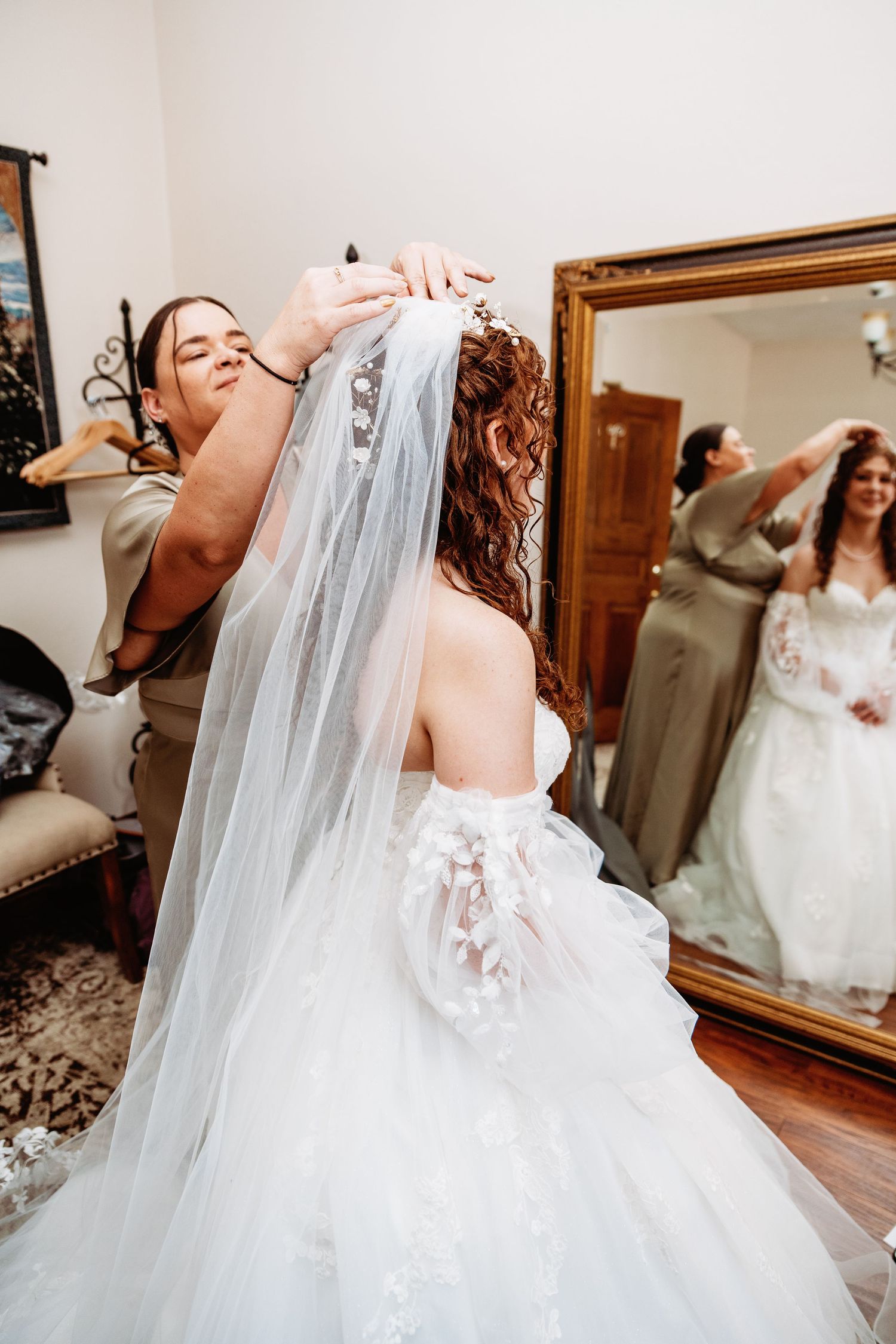
ALREADY THINKING, “YEAH, I WANT HER”?
Cool. I'm Flattered.
Now Let's Talk About Your Wedding.
You don't need to have the timeline figured out.
You don't need to know exactly how many hours of photography you need.
And you definitely don't need to have every wedding-day decision made before you reach out.
That's literally what I'm here for.
Tell me what you know so far.
The date. The place. What you're planning. What matters to you. What you're excited about. What you're already mildly panicking about.
We'll figure out the rest together.
You plan the wedding you actually want. I'll help make sure there's enough time to live the damn thing.
LET'S FUCKING DO THIS →